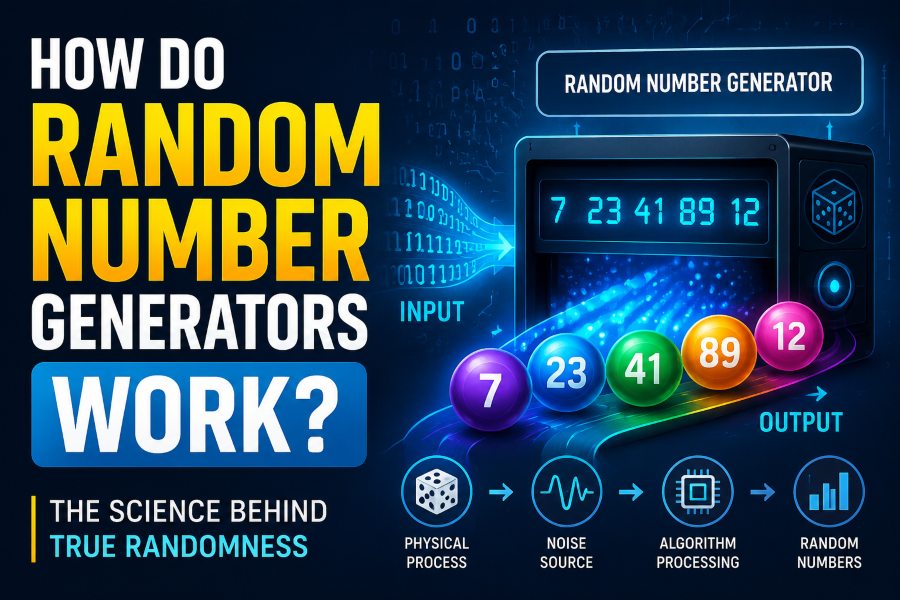
Random numbers are everywhere in modern technology. They help create secure passwords, power online games, support scientific research, shuffle playlists, generate lottery numbers, and even protect financial transactions. Whenever you use a random number generator, a complex process happens behind the scenes to produce values that appear unpredictable.
But how do random number generators work? Are computers truly able to create random numbers? Since computers follow programmed instructions, generating something completely random is more complicated than it seems.
A random number generator (RNG) is a system or algorithm designed to produce numbers without an obvious pattern. Some generators use physical events from the real world, while others rely on mathematical formulas to create sequences that behave like random results.
Understanding how random number generators work helps explain why they are important in programming, cybersecurity, gaming, statistics, and everyday digital applications.
What Is a Random Number Generator?
A random number generator is a tool, program, or device that creates numbers randomly within a specific range. For example, a random number generator might produce numbers between 1 and 100, select a random winner from a list, or create unpredictable values for encryption.
The main purpose of an RNG is to remove human patterns and provide unpredictable results.
A simple example would be rolling a dice. Each roll has a chance of producing a different number, and the result cannot be easily predicted before the roll happens.
Computers, however, do not work like physical dice. They follow instructions and calculations. Because of this, computer-generated randomness requires special techniques.
There are two major categories of random number generators:
- True Random Number Generators (TRNGs)
- Pseudo-Random Number Generators (PRNGs)
Both methods create random-looking numbers, but they work in completely different ways.
True Random Number Generators (TRNGs): Using Real-World Randomness
True random number generators create randomness by measuring unpredictable physical events. These events occur naturally and cannot be controlled or predicted with normal computer calculations.
Examples of physical sources used by TRNGs include:
- Electronic noise
- Radioactive decay
- Atmospheric changes
- Mouse movements
- Keyboard timing
- Temperature fluctuations
- Quantum effects
Because these sources come from the physical world, they provide genuine randomness.
How True Random Number Generators Work
A true random number generator usually follows three basic steps:
1. Collect Physical Data
The system collects unpredictable information from a physical source.
For example, an electronic device may measure tiny changes in electrical signals. These changes happen naturally and are difficult to predict.
2. Convert Data Into Numbers
The collected physical information is converted into digital values that computers can understand.
For example, small variations in electrical noise can be transformed into binary numbers:
010101101001
3. Generate Random Output
The processed data becomes the final random number used by an application.
Because the original source is unpredictable, the generated numbers are considered truly random.
Where Are True Random Number Generators Used?
TRNGs are commonly used in areas where security is extremely important.
Examples include:
- Encryption systems
- Military communication
- Cryptocurrency security
- Secure authentication
- Random cryptographic keys
For example, when creating a secure encryption key, predictable numbers could allow attackers to break the system. True randomness helps prevent this problem.
Pseudo-Random Number Generators (PRNGs): The Most Common Method
Most software applications use pseudo-random number generators because they are faster and easier to implement.
A pseudo-random number generator does not create true randomness. Instead, it uses mathematical algorithms to generate sequences of numbers that look random.
The word “pseudo” means “false” or “not genuine.” This means the numbers are not truly random but appear random to users.
How Do Pseudo-Random Number Generators Work?
A PRNG starts with an initial value called a seed.
The seed is a starting point that determines the entire sequence of generated numbers.
For example:
Seed: 12345
The algorithm processes this value and creates a sequence:
42
87
15
63
29
If the same seed is used again, the generator will produce the exact same sequence.
This predictable behavior is useful for testing, simulations, and programming.
The Role of Algorithms in Random Number Generation
A PRNG uses mathematical formulas called algorithms to transform the seed into new values.
One traditional method is called the Linear Congruential Generator (LCG).
The algorithm follows a mathematical process where each new number depends on the previous one.
Although simple generators are easy to understand, modern applications use much more advanced algorithms to improve randomness.
Popular PRNG algorithms include:
- Mersenne Twister
- Xorshift
- PCG (Permuted Congruential Generator)
- Cryptographically Secure PRNGs
These algorithms are designed to create longer and more unpredictable sequences.
Why Do Computers Need Random Numbers?
Random numbers are essential in many areas of computing. Without them, many modern technologies would not work properly.
Gaming and Entertainment
Online games use random number generators for many features, including:
- Character rewards
- Loot drops
- Card shuffling
- Random maps
- Game events
For example, when opening a virtual treasure chest in a game, an RNG decides what item you receive.
Without randomness, games would become predictable and less enjoyable.
Cybersecurity and Encryption
Security systems rely heavily on random numbers.
When you log into a website, transfer money online, or send encrypted messages, random values help protect your information.
Random numbers are used for:
- Password generation
- Security tokens
- Encryption keys
- Authentication codes
If attackers could predict these numbers, they could potentially access private information.
Scientific Research
Scientists use random number generators for simulations and experiments.
Examples include:
- Weather forecasting
- Physics simulations
- Medical research
- Statistical analysis
Researchers often use millions of random values to model real-world situations.
Online Tools and Applications
Many websites use random number generators for everyday tasks.
Examples include:
- Random number wheels
- Lottery number generators
- Name pickers
- Decision-making tools
- Sampling tools
These tools help users make unbiased selections.
How Do Random Number Generators Create Random-Looking Results?
A computer algorithm cannot create true randomness by itself because every calculation follows a fixed rule.
Instead, PRNGs create randomness through complexity.
A good random number generator should have:
Unpredictability
Users should not be able to guess future numbers based on previous results.
Uniform Distribution
Every possible number should have an equal chance of appearing.
For example, a random number generator from 1 to 10 should not produce 7 more often than other numbers.
Long Period
The sequence should take a very long time before repeating itself.
A short sequence would quickly become predictable.
Efficiency
The generator should create numbers quickly without using too many computer resources.
Are Random Number Generators Really Random?
The answer depends on the type of generator.
True random number generators produce genuine randomness because they rely on unpredictable physical events.
Pseudo-random number generators are not completely random because they follow mathematical formulas.
However, high-quality PRNGs are usually random enough for most everyday applications.
For example:
- Video games usually do not require true randomness.
- Scientific simulations can use high-quality PRNGs.
- Encryption requires stronger random generation methods.
The level of randomness needed depends on the purpose.
What Is a Random Seed?
A random seed is the starting value used by a pseudo-random number generator.
Think of a seed like the first domino in a long chain. Once the first domino falls, the rest follow a specific pattern.
If two computers use the same algorithm and the same seed, they will generate the same results.
Developers use seeds for:
- Reproducing experiments
- Testing software
- Creating consistent simulations
Many programming languages automatically create seeds using system time.
For example, if the current time is used as a seed, the generated sequence changes every time because the starting point is different.
Common Random Number Generator Algorithms
Different applications require different types of random generation. Some popular algorithms include:
Linear Congruential Generator (LCG)
LCG is one of the oldest random number algorithms.
It is simple and fast but not suitable for modern security applications because patterns can sometimes be detected.
Mersenne Twister
Mersenne Twister is widely used because it produces high-quality random sequences.
It has a very long period and is popular in simulations and programming languages.
Cryptographically Secure Random Number Generator (CSPRNG)
CSPRNGs are designed for security applications.
They are used for:
- Encryption
- Password generation
- Secure authentication
These generators make it extremely difficult to predict future values.
Random Number Generation in Programming
Developers frequently use built-in random functions in programming languages.
Examples:
Python:
import random

number = random.randint(1, 100)
print(number)
JavaScript:
let number = Math.floor(Math.random() * 100) + 1;
console.log(number);
These functions allow developers to quickly create random values.
However, developers must choose the correct random method depending on their needs.
For example:
- Games can use normal random functions.
- Password systems should use secure random generators.
Limitations of Random Number Generators
Although modern RNGs are powerful, they have limitations.
Predictability
Poorly designed generators can create patterns that attackers may discover.
Repetition
Every PRNG eventually repeats its sequence because it has a limited number of possible states.
Incorrect Usage
Using the wrong generator for a specific purpose can create security problems.
For example, using a basic random function for encryption could expose sensitive data.
The Future of Random Number Generation
Technology continues to improve random number generation.
Quantum computing and quantum physics are creating new opportunities for generating randomness.
Quantum random number generators use unpredictable quantum events to produce extremely secure random values.
Future applications may include:
- Advanced cybersecurity
- Secure communication networks
- Better artificial intelligence systems
- More accurate scientific simulations
As technology becomes more connected, the need for reliable randomness will continue to grow.
Conclusion: Understanding How Random Number Generators Work
Random number generators are an important part of modern technology. They help power everything from online games and random selection tools to advanced encryption systems.
True random number generators use unpredictable physical events to create genuine randomness, while pseudo-random number generators use mathematical algorithms to produce fast and efficient random-looking results.
Although computers cannot create randomness in the same way nature does, modern algorithms are powerful enough to provide reliable results for most applications.
Whether you are generating a random number for a simple decision, building software, analyzing data, or protecting digital information, random number generators play a critical role in making technology safer, smarter, and more useful.
Understanding how random number generators work gives us a better appreciation of the hidden systems that support our digital world every day.